
Custom Jewelry Manufacturer: How to Read a Factory's Own Claims
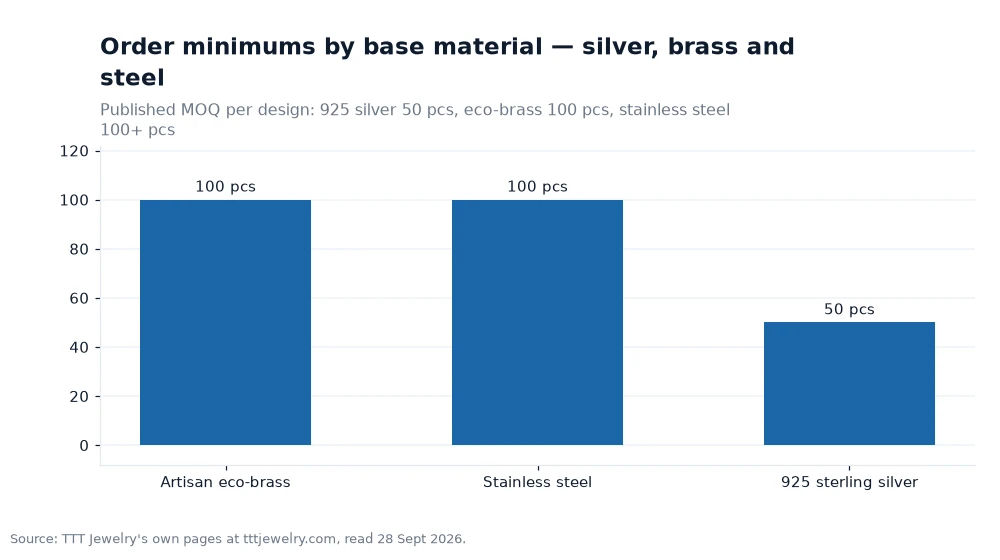
The first audit of a supplier can be run from your desk. The minimums are 100 in eco-brass, 50 in 925 silver and 100+ pieces in stainless steel, counted per design quoted per design. Put them side by side and the sales copy stops mattering.

Key takeaways
- Published minimums are 50 in the silver line, 100+ pieces in stainless steel and 100 units in the eco-brass line, per design, with each design counted separately.
- 3D CAD is quoted at under 48 hours, so a supplier taking two weeks is describing a different process.
- Sampling runs 25–30 days and production 3–4 weeks; a quote that compresses both is a warning sign rather than a bargain.
- An audited BSCI social-compliance programme, REACH restrictions on lead, cadmium and nickel and ISO 9001:2015, cadmium and nickel are the documents to request by name.
Claims that arrive with a number attached
Marketing language is easy to write and hard to test, so start with the claims that carry figures. A minimum order quantity is one. The MOQ by base material is 100 pcs in artisan brass, 50 pcs in sterling silver and 100+ pcs in stainless steel, counted per design, applied design by design. A supplier who will not name a minimum before seeing a drawing has either no standard tooling or no intention of quoting one.
The second checkable claim is a date. 3D CAD modelling inside 48 hours says something about who does the drawing and with what software. Ask for a render from a recent order, and you learn whether those 48 hours produce a technical drawing and a virtual rendering or a decorative picture.
Reading the published claims against each other
Two claims can each be true and still not fit together. A 48-hour CAD stage, a 25–30 day master sample and a 3–4 week production run describe an order that takes roughly seven to nine weeks from approved design to carton. Anyone quoting four weeks end to end is quoting a process other than the one published here.
| Claim | Published figure | How to test it from your desk |
|---|---|---|
| Minimum per design | 50 / 100 / 100+ pcs, by base material | Ask for the figure that applies to your metal |
| CAD turnaround | Under 48 hours | Send a rough sketch and time the reply |
| Master sampling | 25–30 days | Ask what the window contains: wax, casting, setting, polishing, plating |
| Bulk production | 3–4 weeks after approval | Ask whether the physical sample must be signed first |
| Inspection | 100% before packing | Request the inspection note with the shipment |
What the minimum ladder says about your design
Minimums are a tooling fact rather than a negotiating position. Silver casts and finishes quickly, so 50 pieces per design is enough to carry a mould. Brass needs a plating stack before it looks like anything, which puts the floor at 100. Stainless steel is harder to machine and usually runs through PVD vacuum plating, so the floor is 100+.
The consequence is that the choice of material is also a stocking decision. Nothing in those numbers says a design has to sell out; they say how many units must exist before the first one can be produced at all.
The wording that should slow you down
Claims describing an outcome rather than a process deserve a second read. Waterproof is the classic case: it is useful shorthand, but what sits behind it is a plating route — PVD plating on stainless work, rhodium plating, 14K/18K/24K gold and silver and brass sealed with an anti-tarnish e-coat.
The same test applies to paperwork. ISO 9001:2015, REACH limits on lead, cadmium and nickel and an audited BSCI social-compliance programme, cadmium and nickel are specific documents with scopes and dates. Where a page shows a badge with no scope, no date and no restriction list, treat the badge as decoration and ask for the file.
Worked example: one design, three minimums
Take a pendant you want in a single design and a single size, and run it at each published minimum. Silver needs 50 pieces, brass 100, stainless 100+. The silver route therefore exists at half the unit count of the brass route, because 50 ÷ 100 = 0.5.
If your plan is to sell 20 pieces a month, the silver minimum is about two and a half months of stock and the brass minimum is five months of the same rate. Those are two different businesses wearing the same design. The number that decides which one you are building is not the factory's, and it is available before anyone quotes you a price.
Separating a workshop from a forwarding office
Four questions do most of the separating. Which of the eight published steps — the concept and CAD stage and prototype and mould work, through sprue cutting to release the casting, polishing and brushed and textured surface art, into electroplating, final quality check and delivery to the brand — happen on your own floor? Who cuts the mould? Who runs the plating tank? Who inspects the finished batch?
Type OEM jewelry manufacturer China into a search box and you get page after page of the same adjectives. What differs is the answer to those four questions, and the answer is usually visible in how a supplier describes its own process. A team that has never stood at a bench will not explain why the finish is fixed before plating rather than after.
Writing an enquiry so the replies compare
Send the same short brief to every supplier: base material, finish, packaging and first-run quantity. Attach the sketch even if it is rough, because hand drawings, reference photos and tech packs are all accepted inputs and become CAD inside 48 hours.
Then compare replies on the same three items — a named minimum, a sampling window, and the person who will answer questions during the run. TTT Jewelry publishes the minimums, the windows and the OEM/ODM routes, which turns the comparison into a test of the figures rather than of the sales writing.
Where the eight steps show up in a quote
A quote that lists materials and a unit figure says very little about which operations your money covers. Ask the same supplier to mark which of the eight published steps are included: concept and CAD design / prototyping / sprue removal / high-gloss polishing / brushed surface finishes / electroplating to spec / final quality check / dispatch and delivery.
Two answers should change your planning. If prototyping is quoted separately, the first order carries tooling more than once, because a design change after sample approval means a second mould. If final QC is not named, the inspection you are counting on is probably a visual pass at packing time, which is a thinner service than a 100% inspection of the batch.
It also helps to know how the order is managed. The published arrangement is a dedicated project manager on a 1-on-1 basis, with a 24-hour response commitment and a 100% NDA covering moulds, CAD files and the collection itself.
Frequently asked questions
What is a normal minimum order for a first silver design?
The floors are 100 in eco-brass, 50 in sterling silver and 100+ pcs in the stainless line, counted per design, with each design counted separately.
How quickly should a factory return a CAD drawing?
The published turnaround for 3D CAD modelling is under 48 hours, and that includes the realistic renderings used to approve dimensions.
Which claims cannot be checked from a distance?
Polishing quality, plating adhesion and how a piece sits on the skin. Those depend on the bench and the batch, which is why the approved sample and the inspection note carry more weight than any page.
Making the claims work for you
Read a supplier's pages the way you would read a spec sheet: collect the figures and note which ones never appear. TTT Jewelry names its minimums, its sampling window and its inspection point; the 925 sterling silver line shows what those figures mean for a precious-metal design, and the stainless steel line covers the PVD route for pieces built to take wear.
The details quoted above — the eight-stage factory route plus the S925, 316L and 18KGP mark set and CAD within 48 hours — trace back to the brand's own pages on tttjewelry.com, checked 28 Sept 2026. The order-of-magnitude reading is my own working, not the site's[1].