
Luxury Fragrance Production: What to Prepare Before the First Call
The first call with a premium fragrance manufacturer is usually treated as a listening exercise. It goes better as a decision exercise. Brands that arrive with the price point, the pack direction, the volume band and the market list already settled get a materially different conversation, because the manufacturer can talk about feasibility instead of about possibilities. Preparation is not paperwork; it is the difference between a quotation and an estimate.
Key takeaways
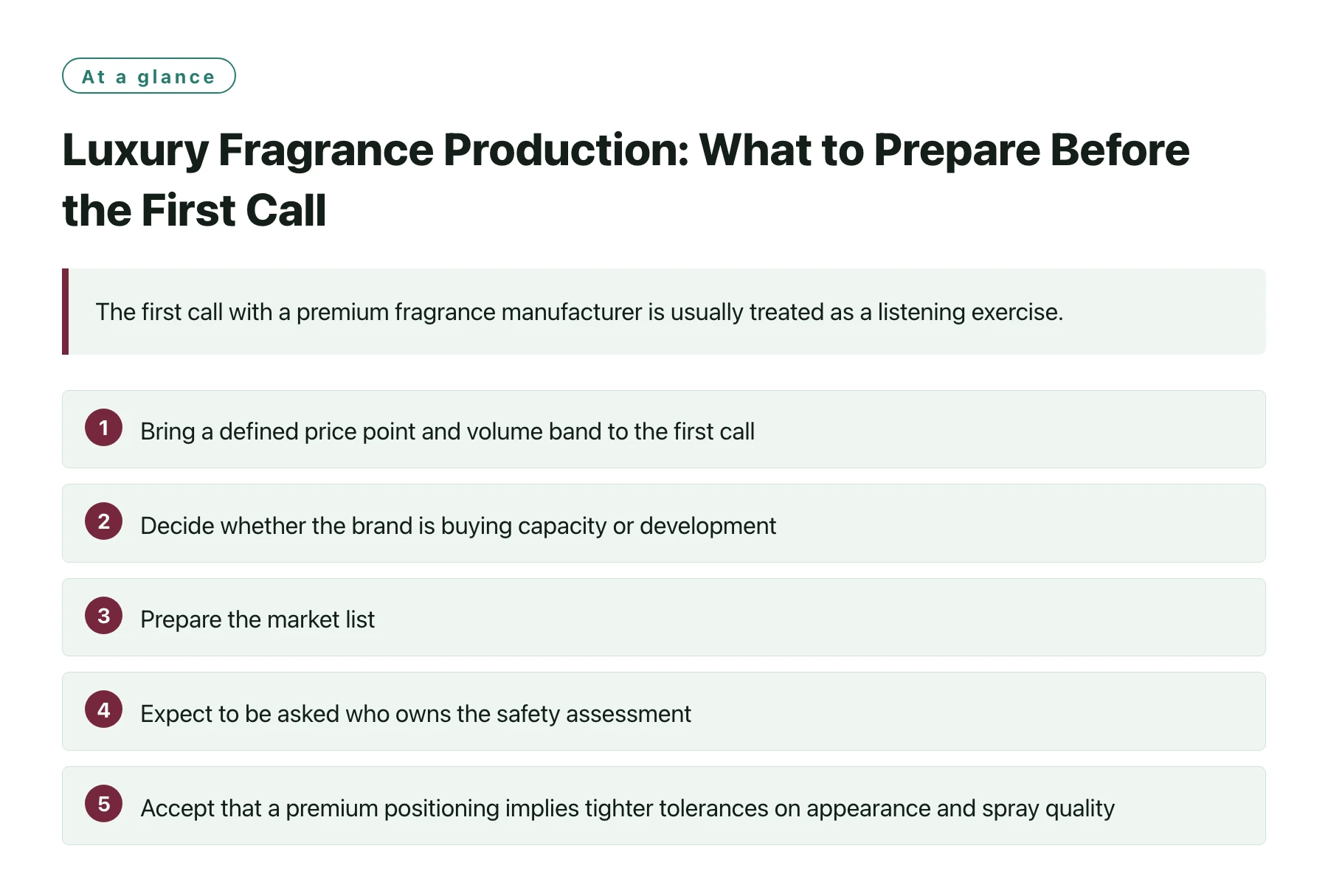
- Bring a defined price point and volume band to the first call, since both determine which materials and components are even worth discussing.
- Decide whether the brand is buying capacity or development, because the two conversations involve different teams and different timelines.
- Prepare the market list, including markets reached through distributors, as label and documentation requirements follow from it.
- Expect to be asked who owns the safety assessment, because the responsibility for placing a cosmetic product on a market sits with the company behind it even when the work is delegated [1].
- Accept that a premium positioning implies tighter tolerances on appearance and spray quality, not only on the scent, and budget the extra checks accordingly.
A luxury fragrance programme usually begins with a founder, a mood and a price point, in that order. The supplier call is the moment those abstractions meet production, and the questions asked there set the cost structure for everything that follows.
Preparation changes the quality of the answers more than preparation changes the supplier. The list below is what a well-prepared brand has finished before dialling, and the second half of the article covers the trade-offs that will come up in reply. It is written on the assumption that the brand is approaching a premium fragrance manufacturer rather than a general filler, because the expectations on both sides are different.
The prep pack: what to have finished before the call
- A retail price point and a channelState where the product will be sold and at what price. Premium positioning without a channel is a mood; with a channel it becomes a cost ceiling the supplier can work against. For a travel retail launch, say so, because the operator's share and the pick-up price change the ceiling.
- A volume band for the first runGive a range rather than a single figure, and say whether the second order will be larger or smaller. Component tooling decisions depend on the answer.
- A pack direction, even if unresolvedBring two or three directions rather than one final choice. The pack determines the compatibility work, and the manufacturer can tell you which directions carry tooling risk.
- A fragrance brief with priorities rankedSay which matters most: the opening, the drydown, longevity, or a specific material story. A brief that ranks nothing gets a submission that ranks nothing.
- The market list and its documentation implicationsInclude destinations reached through distributors. Each market adds label text, documentation or both, and the list has to be known before artwork starts.
- A named decision maker on the brand sideOne person who can approve a submission, a sample and a specification change. Shared approval is the most common cause of a slipped luxury schedule, and a travel retail listing date does not move for an internal review.
- An idea of what the brand will not compromise onPick two or three non-negotiables, such as a material story or a decoration technique. Everything else has to be flexible, and saying so in advance makes the trade-offs easier to price.
The trade-offs the call will raise
Development depth against calendar
A premium brief can be developed in many directions, and each direction costs a submission round and a sample cycle. Manufacturers that support luxury work usually want to know how many rounds the brand has budgeted before they start, because a programme that expands from two rounds to six has a different cost and a different end date.
The productive answer is to spend the rounds where the differentiation lives. If the story is the material, spend the rounds on the formula. If the story is the pack, spend them on the decoration and the closure, and keep the formula modest. Premium launches rarely differentiate on both at full depth within one calendar.
Tighter tolerances against reject rates
Luxury positioning implies narrow acceptable variation in colour, clarity, decoration alignment and spray quality. Narrow windows are legitimate and they cost: more inspection, more rejects, and often a slower line. Discuss the tolerances as a cost rather than as a quality principle, because that is how the manufacturer will price them.
It is worth asking directly how the tolerances are inspected and who signs the release, because that is where a premium programme is won or lost. A manufacturer that can describe quality control in luxury fragrance production in terms of gates, sampling plans and named approvers is describing a system; one that describes an intention is describing a hope.
The same applies to small-batch production. Short runs with high inspection ratios can cost more per unit than a larger run of the same product, which is why a first order sized purely to reduce inventory risk can create a price that never recurs.
In-house scope against specialism
One manufacturer can carry the programme from formula to finished box, which shortens the loop between a decision and its consequence. The alternative splits the pack to a specialist and keeps the fragrance with the filler, which can raise the ceiling on decoration quality and adds a coordination layer the brand has to own.
The consolidated route is usually described as a single partner from formula to finished bottle, and its main advantage is not price but traceability: when the same organisation owns compounding, filling and packing, a change in one place is visible in the others before the pallet is built.
Neither is superior in the abstract. The question is whether the differentiation sits in the liquid or the object, and the first call is the right place to say which one, because it determines who the brand is really hiring.
It also helps to understand how a specialist reads the category. Trade coverage of premium launches tracks how often a fragrance line is judged on its format, its claims and its refillability rather than the scent alone, which is a useful corrective when a brand believes the formula will carry the whole proposition [2].
Stability and appearance over time
At a premium price point, a colour shift that would be unnoticeable elsewhere is a visible defect, and under travel retail lighting on a counter it is more visible still. Materials change over time as they react with oxygen and light, and the rate depends on the material and the pack, so the programme has to test appearance as carefully as it tests scent [3].
This is where the brand's non-negotiables matter. If a signature material changes colour, the choice is between accepting the shift, protecting the formula with a pack that blocks light, or reducing the material. Each option has a cost, and the decision is easier when it is made against a stated priority rather than in the middle of a sample review.
What the first call can and cannot settle
| Topic | Settleable on the call | Needs work afterwards |
|---|---|---|
| Scope and responsibility split | Yes, in principle | Written scope schedule with named owners |
| Component feasibility | Usually, from experience | Tooling review and first-article sample |
| Cost direction | A range with assumptions | Quotation against a frozen specification |
| Timeline | A sequence, not dates | Dated plan once the pack and volume are fixed |
| Compliance and documentation | Who does what | Actual documents for each destination market |
Treat every 'yes' on the call as a hypothesis to be confirmed in writing. The written version is what the order will be run against.
Do not leave the first call without a date for the second one and a list of documents each side owes. A warm conversation with no follow-up date is the most expensive outcome of the meeting.
Sources
- EU Scientific Committee on Consumer Safety (SCCS) —— The EU scientific committee that issues opinions on the safety of cosmetic ingredients, including fragrance allergens and their labelling thresholds.
- Cosmetics Business —— A trade publication covering the beauty and cosmetics industry, including fragrance launches and regulatory developments.
- Chemistry World (Royal Society of Chemistry) —— The Royal Society of Chemistry's magazine, covering chemistry research and explanations of everyday materials including aroma compounds.
Frequently asked questions
How long should the first call with a luxury manufacturer last?
Sixty to ninety minutes is usually enough to establish scope, feasibility and next steps, provided the brand has prepared the price point, volume band, pack direction and market list in advance.
Should a premium brand choose a larger manufacturer?
Not automatically. Size affects capacity and process depth, but the fit depends on whether the brand needs development attention, decoration capability or both.
What if the pack direction is still open?
Bring two or three options rather than none, and ask which carries the most tooling risk. An open question with options is productive; an open question without them stalls the meeting.
How many sample rounds should a luxury brief plan for?
Two to four is typical for a differentiated brief. More is possible, but each round carries cost and calendar, so decide in advance where the rounds will be spent.
Who should attend on the brand side?
The person who can approve the formula and the person who owns the pack, or one person holding both mandates. Delegating approval to a group is what slows premium programmes down.
El vestido merece verse en persona, en nuestro atelier de Claudio Coello.
Reserva una cita privada y descubre los tejidos, las pruebas y el oficio que hay detrás de cada costura.